Jeddah [OEJN]
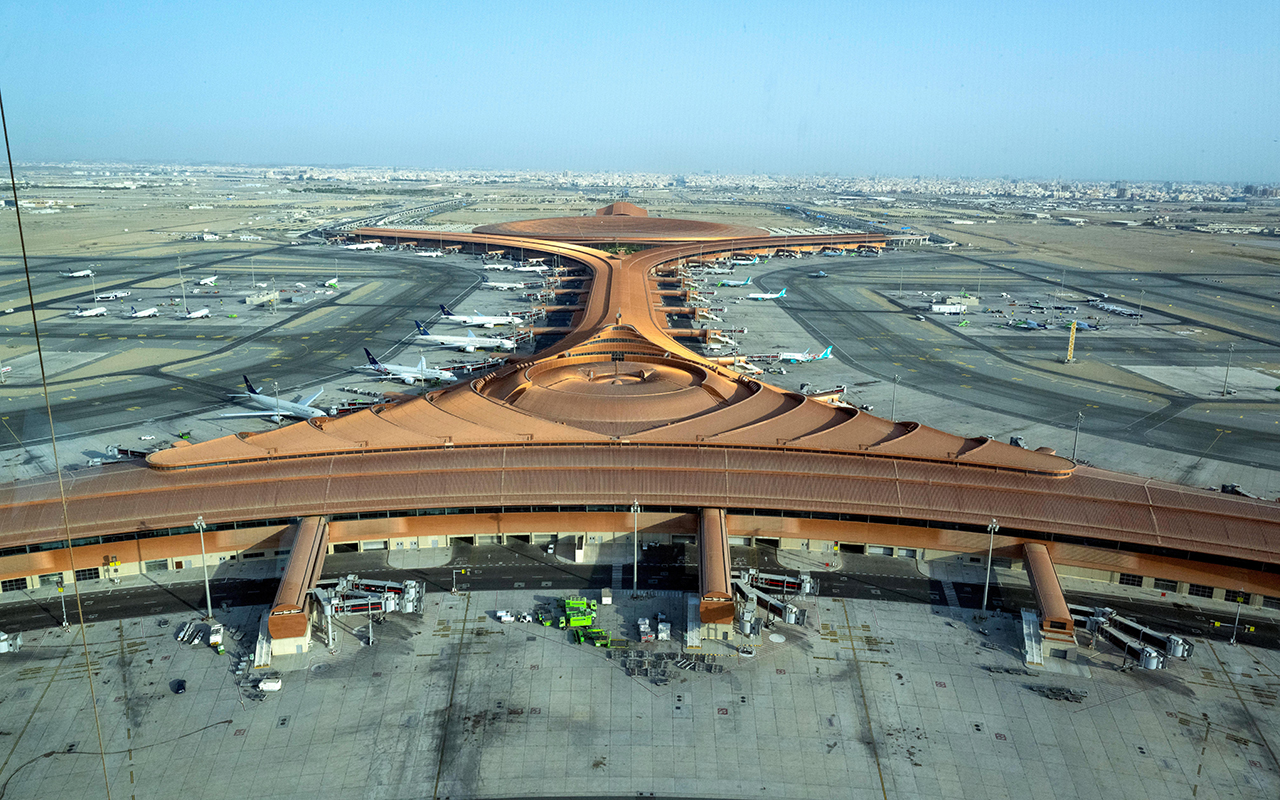
covering
This is the pilot briefing of King Abdulaziz International Airport. All pilots flying out of Jeddah must familiarize themselves with this document prior to the flight.
1. Airport Information
1.1 Jeddah King Abdulaziz International Airport (OEJN)
1.1.1 Airport Overview
King Abdulaziz International Airport (OEJN) is a significant airport serving the cities Jeddah and Mecca in Saudi Arabia. It's situated 19 kilometers north of Jeddah and covers an extensive area of 105 square kilometers. Opened in 1981, it replaced the former Kandara Airport and is named after the founder of Saudi Arabia, King Abdulaziz.
The airport is the busiest in the kingdom and the third-largest by land area and features a royal terminal and three operational passenger terminals, including a dedicated Hajj Terminal for the Islamic Hajj pilgrimage season.
1.1.2 Runway Physical Characteristics
| Runway | Dimensions (m) | True Bearing | Elevation | Slope |
|---|---|---|---|---|
| 34L | 3800 x 60 | 340.00 | 14 | 0.0% |
| 16R | 3800 x 60 | 160.00 | 14 | 0.0% |
| 34C | 3800 x 60 | 340.00 | 28 | -0.06% |
| 16C | 3800 x 60 | 160.00 | 28 | +0.33% |
| 34R | 3800 x 60 | 340.00 | 49 | -0.14% |
| 16L | 3800 x 60 | 160.00 | 30 | +0.14% |
Table 1.1.2 Runway Characteristics
1.1.3 Air Traffic Services
1.1.3.1 ATS Airspace
| Airspace Type | Airspace | Class | Vertical Limits | Controller |
|---|---|---|---|---|
| Control Zone | Jeddah CTR | D | SFC - 2500ft | AIR W, AIR E |
| Terminal Maneuvering Area | Jeddah TMA Part 1 | C | 1500ft - FL195 | APP 1, FIN |
| Terminal Maneuvering Area | Jeddah TMA Part 2 | C | 2500ft - FL195 | APP 1 |
| Control Area | Jeddah CTA East | A | FL150 - FL600 | CTR 1 |
| Control Area | Jeddah CTA West | A | FL150 - FL600 | CTR 2 |
Table 1.1.3.1 ATS Airspace
1.1.3.2 ATS Positions
| Radio Callsign | Logon Callsign | Abbreviation | Frequency (MHz) |
|---|---|---|---|
| Jeddah ATIS | OEJN_ATIS | ATIS | 126.200 |
| Jeddah Delivery | OEJN_DEL | GMP | 121.800 |
| Jeddah Apron | OEJN_E_RMP | APN E | 121.750 |
| Jeddah Apron | OEJN_N_RMP | APN N | 121.975 |
| Jeddah Ground | OEJN_W_GND | SMC W | 121.600 |
| Jeddah Ground | OEJN_E_GND | SMC E | 121.900 |
| Jeddah Ground | OEJN_C_GND | SMC C | 121.700 |
| Jeddah Tower | OEJN_W_TWR | AIR W | 118.200 |
| Jeddah Tower | OEJN_E_TWR | AIR E | 118.500 |
| Jeddah Tower | OEJN_C_TWR | AIR C | 118.300 |
| Jeddah Approach | OEJN_APP | APP 1 | 124.000 |
| Jeddah Final Approach | OEJN_FE_APP | FIN E | 123.800 |
| Jeddah Final Approach | OEJN_FW_APP | FIN W | 124.675 |
| Jeddah Terminal Control | OEJN_W_CTR | CTR W | 125.450 |
| Jeddah Terminal Control | OEJN_E_CTR | CTR E | 119.100 |
| Jeddah Terminal Control | OEJN_WU_CTR | CTR WU | 124.825 |
Table 1.1.3.2 ATS Positions
2. Stands Allocations
2.1 Stands
To ensure immersive experience, pilots are recommended to spawn on the following aprons depending on their real-world airlines gate allocations.
| Aprons | Airlines |
|---|---|
| Apron A | Saudi Airlines |
| Apron B | Legacy Gulf Airlines (SVA, UAE, ETD etc) |
| Apron C | Low cost and major international airlines (KNE,FAD,KAC,THY) |
| Aprons 1,2,3,4,5 | International |
| Aprons 6, 7 | Hajj |
| Apron 9 | Cargo |
| Apron 11 | Hanger (Cargo Overfill) |
| Apron 12 | Military |
| Apron 8 | Royal |
| Apron G | General Aviation |
Table 2.1 Stands Allocations
3. Preflight
3.1 Flight Planning
Depending on the nature of the flight, pilots must fly the correct routes whether normal flight or event flight.
3.1.1 Normal Route(s)
For the majority of departures from Jeddah, SimBrief can automatically generate ATC-compliant flight plans by selecting the "Preferred Route" option. These routes are maintained and revised by our Operations Department with every AIRAC release to reflect the latest Air Traffic Flow Management (ATFM) requirements across the Middle East, while also ensuring successful validation through Eurocontrol's IFPS.
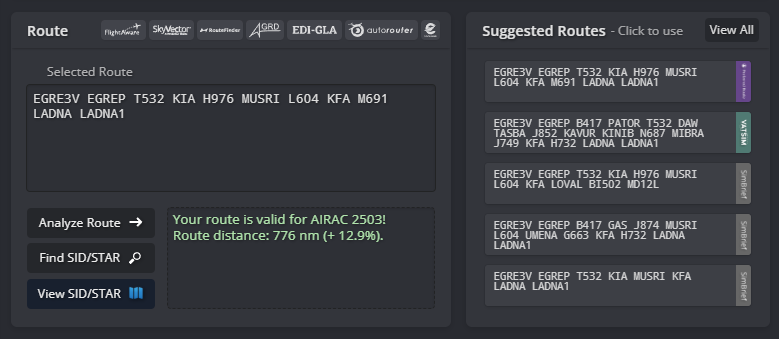
Figure 3.1.1 - Simbrief Preferred Route
3.1.2 Event Route(s)
During the initial phase of the flight, it is mandatory for pilots to prefile with the correct event route either provided by "Suggested Event Routes" in myVATSIM or amended by the Delivery controller. Otherwise, pilots should expect further delays.

Figure 3.1.2 - Suggested Event Routes
3.2 CDM Procedures
3.2.1 CDM Introduction
During large events, Collaborative Decision Making (CDM) will be put in place to regulate the flow of traffic on the ground. When this system is in use, you will be able to view your TSAT at (https://vacdm.vatsimsa.com).
By default, the TSAT is taken from the TOBT that you submitted on the website or the EOBT you filed in the flight plan. Pilots are expected to report ready for pushback/start-up within TSAT+-2. Should you report ready earlier, you may be given an earlier slot depending on the current traffic situation.
For events with individual CTOTs, your TSAT will be generated after you receive your IFR clearance.
| Time | |
|---|---|
| EOBT (Estimated Off-Block Time) | This is the time when you estimate to be ready for pushback during the creation of your flight plan. |
| TOBT (Target Off-Block Time) | This is the time that you target to offblock. Keeping your TOBT up to date will help ATC to reduce delays and ensure a smooth operation. When you set a TOBT, ATC will treat it as a confirmed time and calculate your TSAT based on it. |
| TSAT (Target Startup Approval Time) | This is the time when ATC is planning to approve your startup. Keep in mind that it is ultimately your responsibility as the pilot to request startup within the TSAT window. In an optimal situation, your TOBT and TSAT will be at the same time. However, if there are more aircraft wanting to depart than the airport can currently accommodate, startups will be delayed and your TSAT will be at a later time than your TOBT. |
| CTOT (Calculated Take-Off Time) | This is the actual slot for you to take off from the departure airport. |
Table 3.2.1 CDM Time Definitions
3.2.2 CDM Procedure and Checklist
- Submit your flight plan on VATSIM and connect on the network at least 30 minutes prior your off-block time (or 45 minutes before your CTOT)
- Submit your TOBT on (
https://vacdm.vatsimsa.com) - Check your TSAT on (
https://vacdm.vatsimsa.com) - Request clearance 25 minutes before your EOBT/TOBT
- Be ready and request for pushback/startup at TSAT +-2 minutes
If you failed to pushback/start up within +5 minutes after TSAT
- Inform ATC
- Submit your new TOBT on (
https://vacdm.vatsimsa.com) - Check your new TSAT on (
https://vacdm.vatsimsa.com) - Be ready and request for pushback/startup at new TSAT +-2 minutes
Note
Keep on refreshing the vACDM website to check for SID/RWY/TOBT changes. TSAT updates automatically and does not require you to refresh.
3.3 Getting your clearance
3.3.1 Voice Clearance
Voice communication is the preferred method for obtaining departure clearance. Pilots should contact Jeddah Delivery approximately 10 minutes before start-up and prepare to provide the following information:
- Aircraft Callsign
- Aircraft Type
- Parking Stand
- Requested Flight Level (RFL)
- Destination Airport
- Standard Instrument Departure (and departure speed if unable to comply with SID minimum speed restrictions)
- Departure Runway
- Current Departure ATIS Information
Departure clearances are issued in an abbreviated format and typically include only the assigned SID, departure runway, initial climb altitude, and transponder (squawk) code. Before requesting or accepting your clearance, ensure you have obtained the latest Departure ATIS information.
Example
Pilot: SVA1024, Stand A10L, A320, requesting IFR clearance to Dammam
Controller: SVA1024, Cleared Dammam as filed, EGREP3V Departure, Runway 34R, Initial Climb 6000ft, SQWK XXXX
----------------------------- Pilot Readbacks --------------------------------
Controller: SVA1024, Readback Correct, Information A, Report ready for push and start
3.3.2 Pre-Departure Clearance (PDC)
Pilots wishing to obtain their clearance via Hoppie datalink should send a clearance request to OEJN. A CPDLC logon is not required prior to sending the request, and no readback is required once the clearance has been received.
Warning
Clearance Delivery does not issue pushback or engine start approval. After receiving your departure clearance, remain on the Clearance Delivery frequency and do not transfer to Ground unless instructed. Once your aircraft is fully prepared for pushback—including the jetway disconnected, tug attached, and wheel chocks removed—report fully ready on the Clearance Delivery frequency. When appropriate, and depending on the current airport departure flow, you will be instructed to contact the relevant Ground frequency for pushback and start.
4. Ground Movement Operations
4.1 Pushback Procedures
Pushback and engine start approval may only be requested after Clearance Delivery instructs you to contact the designated Ground frequency. Depending on traffic conditions and apron operations, the ground controller may assign a specific pushback procedure or direction. Pilots must confirm they are able to comply with the instruction and promptly notify the controller if they are unable to do so.
4.1.1 Apron Flow Direction
| Apron(s) | 34 Operations | 16s Operations |
|---|---|---|
| Apron A | Southbound | Northbound |
| Apron B | Southbound | Southbound |
| Apron C | Westbound | Westbound |
| Aprons 1, 2, 3, 4, 5 | Southbound | Northbound |
| Apron 7 | Southbound | Northbound |
Table 4.1.1 Apron Flow Direction
Example
Pilot: ETD901, Stand C3, request pushback
Controller: ETD901, Push & Start Approved, Face West on WA
4.1.2 Colored Taxilines
Code C aircraft operating within Aprons A and B shall use the designated colour-coded taxilines to facilitate efficient and quick ground movement taxi/pushback operations in large aprons.
Pilots unable to push on colored lines shall immediately inform apron/ground controller if cleared for push onto them
| Colors | Taxiways | Maximum Aircraft Code |
|---|---|---|
| Blue | KB, LB | Code C (Aircrafts with a wingspan less then 36m) |
| Orange | KC, LC | Code C (Aircrafts with a wingspan less then 36m) |
Table 4.1.2 Colored Taxilines
Example
Controller: SVA1024, Push & Start approved, face south on the blue line
CDM Procedure
During flow management operations, pushback shall be planned plus or minus 5 minutes from the assigned TSAT. Traffic will only be handed off to apron/ground after this is met.
4.2 Taxi Procedures
Controller may assign different taxi routes or holding points depending on traffic and aircraft characteristics. Pilots are expected to follow all assigned taxi instructions without deviation.
Example
Controller: SVA1024, Taxi via LB, L3, ME, Holding point M2 runway 34R
4.2.1 Taxi Flow
The diagrams below illustrate the standard taxi routes in use. These routes may be modified by ATC to accommodate operational reasons or traffic conditions. In all cases, pilots shall follow ATC instructions if they differ from the published taxi routing.
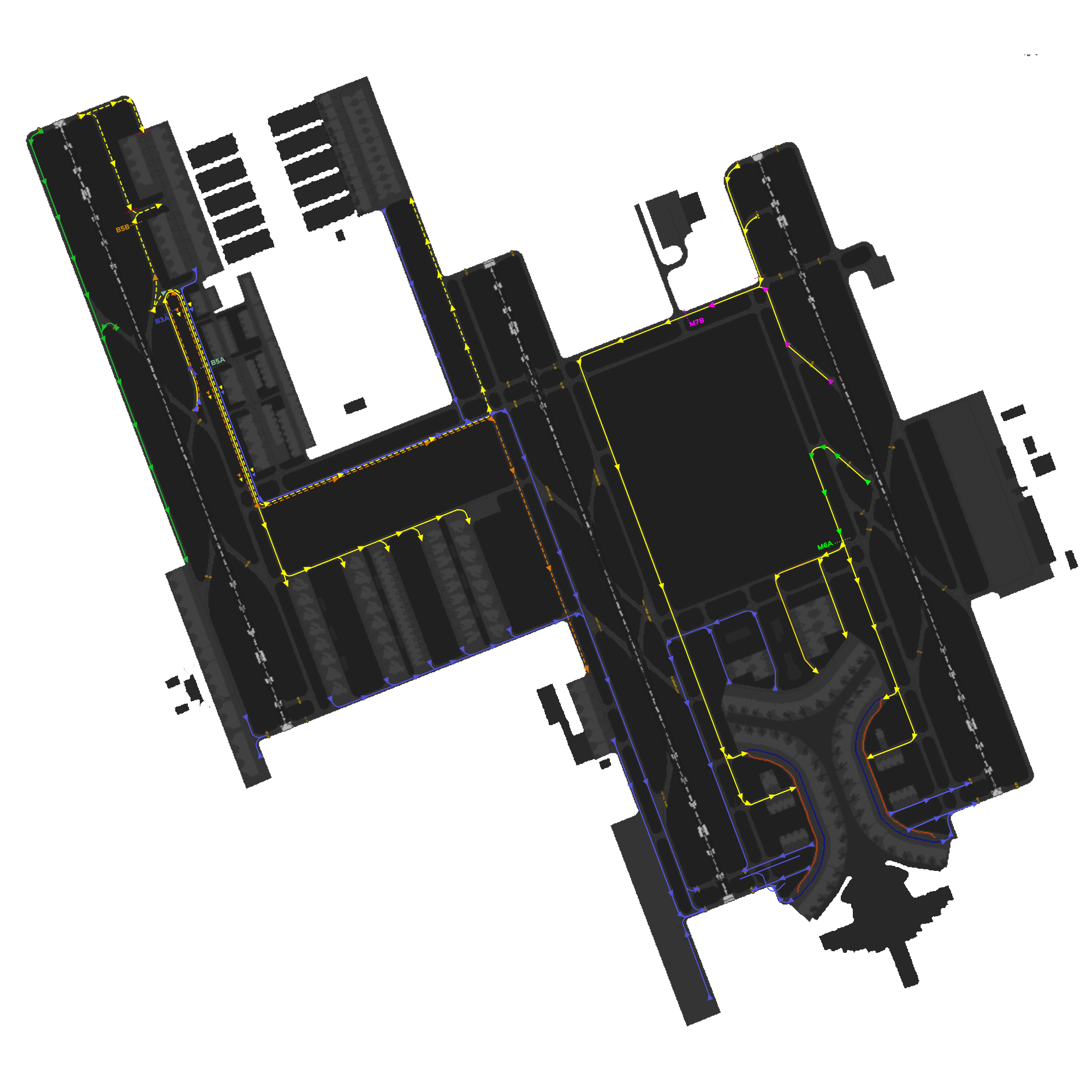
Table 4.2.1 34 DDRO
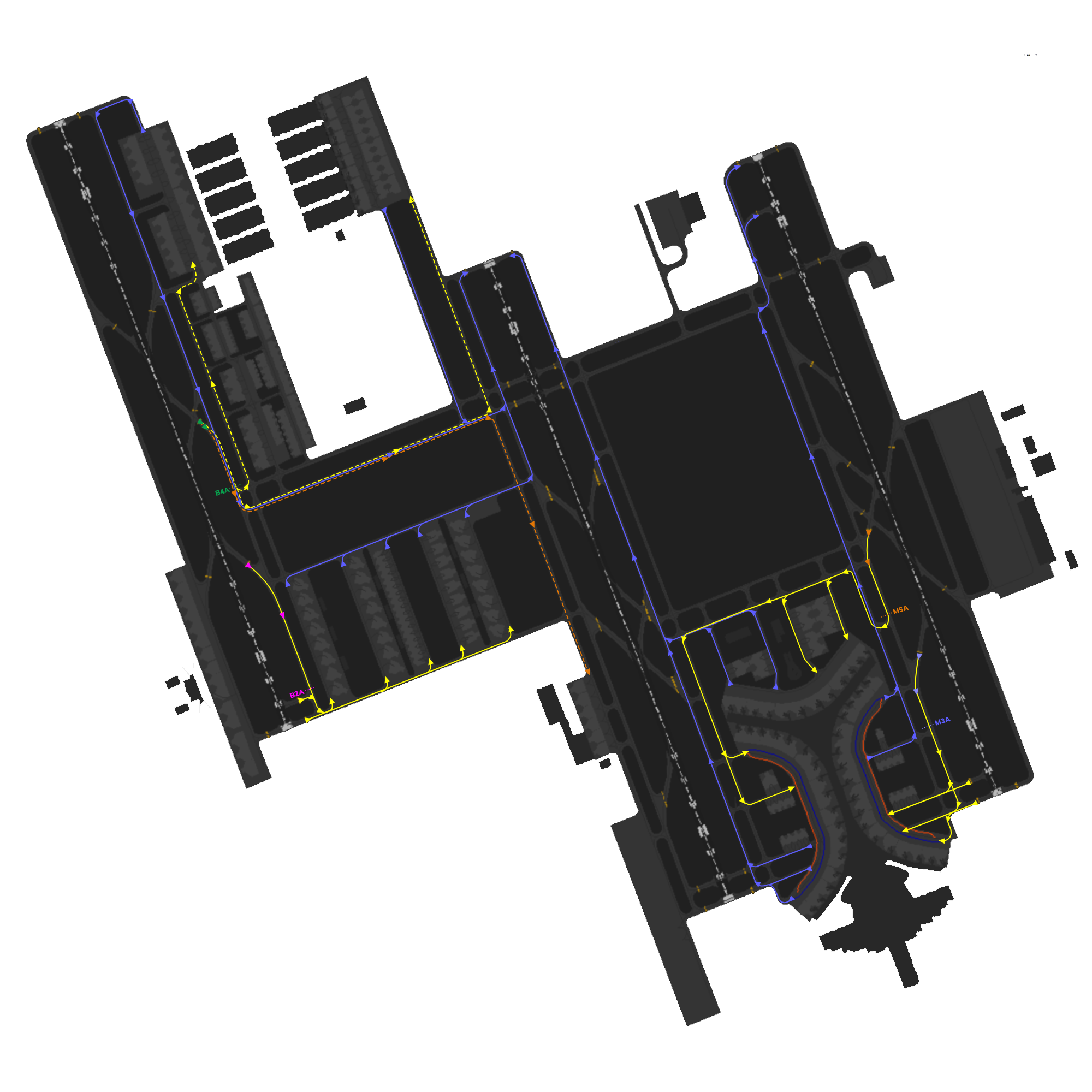
Table 4.2.1 16 DDRO
4.2.2 Departure Holding points
| Runway | Departure point |
|---|---|
| 34L | B1 / U |
| 34C | G1, G2 / H1, H2 |
| 34R | M1, M2 / N1 |
| 16L | M8, M9 / N9 |
| 16C | G6 / H7 |
| 16R | A7 / B7 |
Table 4.2.2 Departure Holding points
5. Departure Procedures
5.1 Standard Instrument Departures (SIDs)
| Exit Points | EGREP | DATAP | MIGDA | BOMOX | KAROX | RIBAM | EGPOB | ISLAM |
|---|---|---|---|---|---|---|---|---|
| 34L | 2X | 2X | 2X | 2X | 2X | 2X | 2X | 2X |
| 34R | 3V | 3V | 3V | 3V | 3V | 3V | 3V | 2V |
| 34C | 2W | 2W | 2W | 2W | 2W | 2W | 2W | 2W |
| 16L | 3D | 3D | 3D | 3D | 3D | 3D | 3D | 2D |
| 16R | 2F | 2F | 2F | 2F | 2F | 2F | 2F | 1F |
| 16C | 2E | 2E | 2E | 2E | 2E | 2E | 2E | 1E |
Table 5.1 Standard Instrument Departures (SIDs)
Omnidirectional Departures
Omni-Directional Departures may be used if an older AIRAC is in use and the latest SID’s are not available.
5.2 Runway Operations
- The preferred runway configuration is 34s when the wind is slacking (less than 6 Kt).
- Expect hand off at 800 feet and passing the threshold (end of the runway).
- Independent Parallel Departures in progress between RWY 34C/16C and RWY 34R/16L.
5.2.1 Minimum Runway Occupancy Time
To maximize runway utilization at King Abdulaziz International Airport, pilots must follow the following procedures:
- On receipt of the line-up clearance, pilots shall taxi into position expeditiously.
- If pilots require more separation than the WTS time-based standard or extra time for any other reason, advise ATC early PRIOR to entering the runway, NOT when on the runway. When informed, ATC may be able to make changes in the departure sequence, if necessary, to minimize delays to other succeeding departures.
- Cockpit checks shall be completed prior to line-up, any checks requiring completion whilst on the runway should be kept to the minimum required. Pilots should ensure that they are able to commence the take-off roll immediately when take-off clearance is issued.
- Once ATC issues a take-off clearance, if there is any unreasonable delay in the aircraft commencing the take-off roll, ATC may cancel the take-off clearance and reposition the aircraft in the departure sequence.
- When cleared for take-off, ATC will expect and will have planned on seeing movement within 8 to 10 seconds of the take-off clearance being issued.
5.3 Altitude Restrictions
All altitude restrictions on the SID are mandatory and must be complied with unless otherwise instructed by ATC.
5.4 Speed Restrictions
- All speed restrictions on the SID are mandatory and must be complied with unless otherwise instructed by ATC. Pilots shall strictly adhere to the speed assigned by ATC and shall request ATC approval before making any changes thereto. If it is essential to make an immediate temporary change in speed, e.g. due to turbulence, ATC shall be notified as soon as possible.
- Pilots should anticipate the following standard speed restrictions. ATC will confirm speed restriction instructions.
- If speed control is considered excessive or contrary to safe aircraft operation, ATC must be informed without delay.