OEJN_W_CTR [CTA W] Briefing Material | Hajj OPS: 2026
Covering
This section details all the necessary briefing materials for OEJN_W_CTR [CTA W] during Hajj OPS: 2026
Designated Area of Responsibility
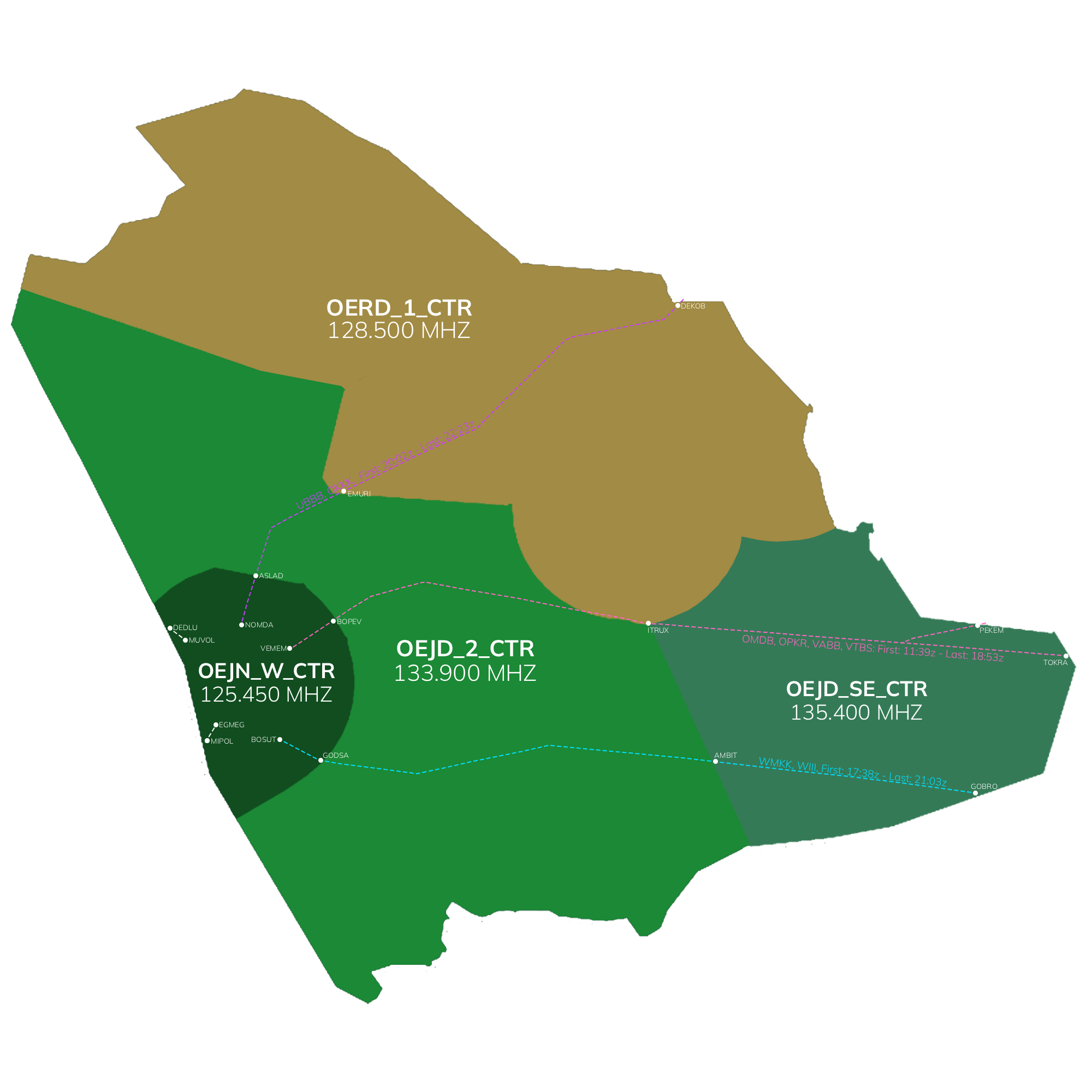
"Jeddah Terminal Control" (OEJN_W_CTR) is the bandbox position in charge of both the Eastern and Western Jeddah CTA Sectors from FL150+.
Notes
- Five separate traffic flows — Western, Southwestern, Northern, Eastern, and Southeastern will enter CTA W airspace at varying times.
- Controllers are required to use the VATCAN plugin to distinguish event traffic from non-event traffic.
- Any non-event aircraft entering the Jeddah FIR with destination Jeddah must obtain a release from the appropriate Jeddah Control sector before entry. Adjacent ACC sectors are responsible for coordinating the release prior to transfer.
- RVSM procedures and the semi-circular cruising level rule are applicable throughout the OEJD FIR.
- Standard separation minima within the airspace are:
- 1,000 ft vertical separation up to FL410 or 10 NM lateral separation.
- 2,000 ft vertical separation above FL410 or 10 NM lateral separation.
- Issuing arrival clearances for traffic inbound to Jeddah is not the responsibility of Jeddah Control; this duty belongs to Jeddah Terminal Control.
- A minimum of 12-15 NM longitudinal spacing must be maintained between arrival aircraft before transfer to Jeddah Approach (APP 1). This means final sequencing and spacing start in this sector
- All aircraft handed off to Jeddah Terminal Control must be descended below FL390.
- Controllers should regularly review ECFMP updates to remain informed of the latest traffic flow restrictions and measures.
- All arrivals into the Jeddah CTA will be FL390 or below.
- All handoffs from Cairo Control (HECA) via DEDLU shall enter FL290 or below.
- Any non-event traffic entering the Jeddah CTA to be held at the Jeddah TMA entry points if they cannot be sequenced.
Arrivals to assign
- STARs into OEJN will be assigned by Jeddah Terminal Control (CTA W) and will be based on the route. Not based on where they park.
- The following table dictates the STARs that should be assigned to arrivals based on their CTA and TMA entry point.
| Handoff From | TMA Entry | CTA Entry | STAR |
|---|---|---|---|
| ACC 2 | NOMDA | ASLAD | NOMDA2L |
| HECC | MUVOL | DEDLU | MUVOL2L |
| ACC 2 | VEMEM | BOPEV | VEMEM2N |
| HSSS | EGMEG | MIPOL | EGMEG2N |
| ACC 2 | BOSUT | GODSA | ULULU2N x IMLER1N trans. |
Delay Phases
Incase of TMA overload, the following delay phases can be initiated by Jeddah Approach (APP 1) or Jeddah Terminal Control (CTA W). All delay phases should be coordinated with the designated "HAJJ OPS HELP" staff member or Ismail Hassan. After initiation of a delay phase, this should be announced globally in the ATC chat on EuroScope.
All temporary holding procedures can be found here.
| Phase | Initiated By | Description |
|---|---|---|
| P1 | APP 1 | Arrivals into OEJN will be slowed down to delay the hourly rate into the TMA. Relevant flow measures to be put in place. |
| P2 | APP 1 and CTA W | APP and CTA to agree on this phase prior to coordination with staff members. All handoffs into the Jeddah TMA will be stopped. Holding will be initiated at the TMA entry points (e.g. VEMEM, NOMDA, MUVOL). Holding stacks to be managed by CTA. |
| P3 | CTA W | All handoffs into the Jeddah CTA will be stopped. Holding will be initiated at the CTA entry points (e.g. BOPEV, ASLAD, GODSA). Holding stacks to be managed by ACC. |